
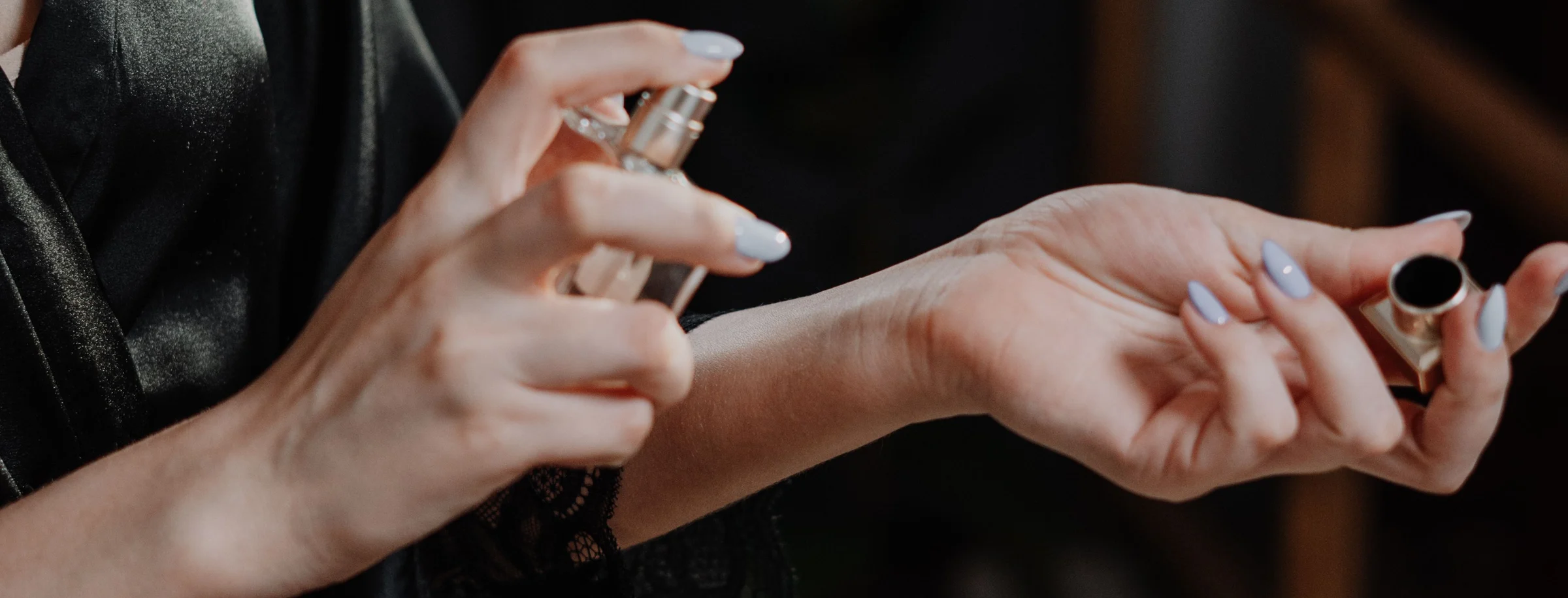
Perfume layering means wearing two or more perfumes at the same time. The perfumes are applied one over the other or on different parts of the body, and together they give a scent that neither gives alone. Wearing a perfume with a cream, oil or shower gel of the same scent is also called layering.
Layering in the Middle East
In the Middle East, layering scents is part of everyday life. A musk cream goes on the skin first, followed by perfume. Then bakhoor, a blend of oud and resins, is burned, and a Western perfume often comes last. Men wear several scents at once too, with oud, leather, saffron and rose prevailing.
In the West, some perfumers oppose layering, because they see a perfume as a finished work that is not meant to be mixed with another.
Which perfumes go together
Two perfumes combine most easily when they have some notes in common. When both contain vanilla, musk or cedar, that note links them.
Perfumes also go together when each adds what the other lacks. A fresh citrus perfume becomes warmer with vanilla or amber, and a dark, dense one softer with an Eau de Cologne or a gentle musk.
Perfumes with one or two prominent notes combine more easily than those with many. Two strong, complex perfumes cover each other, and neither can be made out.
The order of application
The stronger perfume goes on first and the lighter one over it. Applied over the lighter one, the stronger perfume would cover it.
The perfumes can also go on different spots, one on the neck and the other on the wrists, so each can be smelled on its own as well as together.
Layering and longevity
Layering can also make a scent last longer. Citrus evaporates quickly, woods and musk slowly. When a fresh perfume is applied over a woody or musky one, the scent remains on the skin after the citrus has gone.
Longevity also depends on perfume concentration, so an extrait is sometimes applied to the skin and an Eau de Parfum or Eau de Toilette to clothing.
Perfume lasts longer on moisturised skin than on dry skin. An unscented cream does not change the perfume.
Perfumes made for combining
Some brands compose their perfumes so that they can be worn both alone and together. Fascent is one of them, and names for each perfume which of the others it goes with. It recommends wearing Sel À Vie and L’Eau D’or Dort together.
Fascent Sel À Vie
Sel À Vie starts with mandarin and sweet orange. Ylang-ylang, jasmine and tiare are at its heart, and sea salt, driftwood and vanilla form the base.
Explore Sel À VieFascent L’Eau D’or Dort
Bergamot, citron and lemon open L’Eau D’or Dort. Orange blossom, petitgrain and a clean linen accord are at its heart, and aldehydes and white musk form the base.
Explore L’Eau D’or DortBoth open with citrus and have flowers at the heart. Sel À Vie adds vanilla, sea salt and driftwood to the fresh, clean L’Eau D’or Dort.
Two sweet perfumes
Perfumes that a brand does not name as a pair can be combined too. Pear Pavlova and Vanilla for Breakfast are both by French Cowboy, and both are built around sweet, dessert-like notes.
French Cowboy Pear Pavlova
Pear Pavlova is built around juicy pear, soft musk and meringue. Pink pepper, bitter almond and jasmine sambac go with them.
Explore Pear PavlovaFrench Cowboy Vanilla for Breakfast
Vanilla for Breakfast is built around almond milk, vanilla and roasted tonka. French Cowboy combines four different vanillas in it, and sweet almond opens it.
Explore Vanilla for BreakfastAlmond links them, bitter in Pear Pavlova and sweet in Vanilla for Breakfast. Vanilla for Breakfast brings creamy vanilla and roasted tonka to the pear and meringue.
Trying a combination
Two perfumes can first be smelled together on blotters. On the skin they change, and every skin is different, so the same combination does not smell alike on two people.
Discovery sets, with several perfumes from one brand, are practical for trying combinations.