
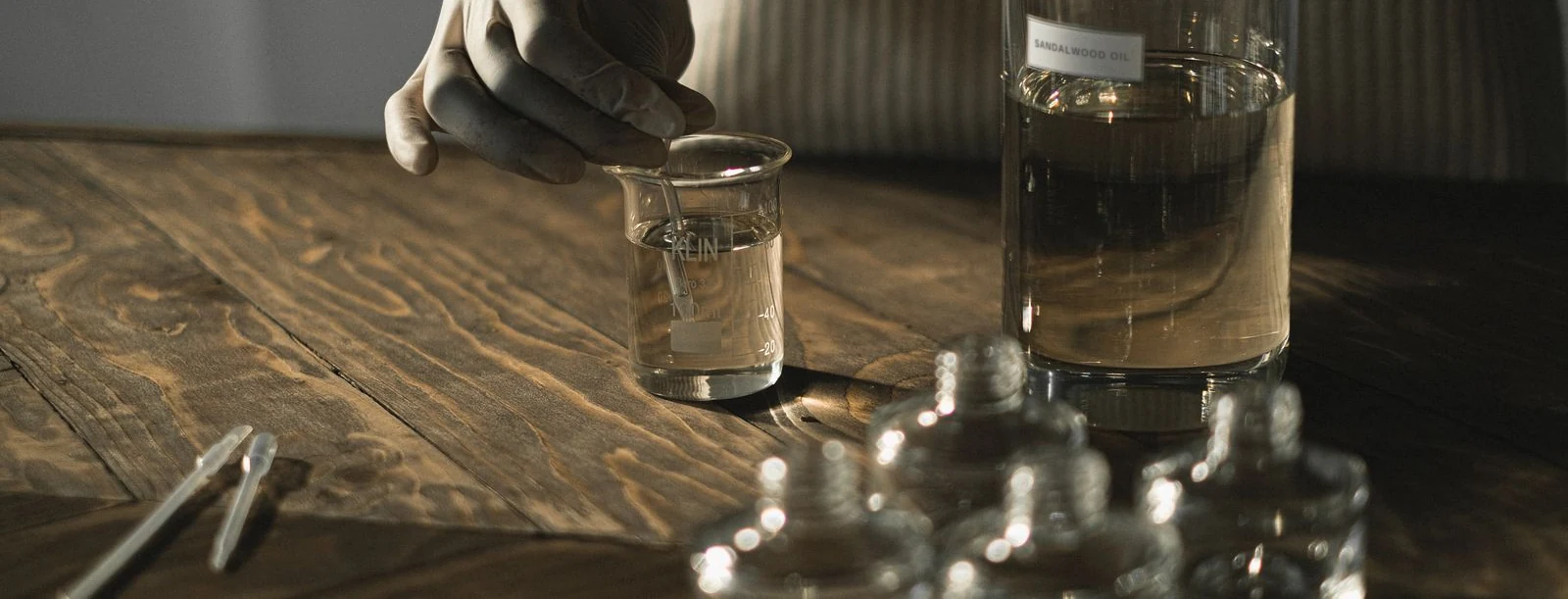
EDP stands for Eau de Parfum and EDT for Eau de Toilette. Together with Extrait de Parfum, they are the most common concentration labels. Each says roughly how much perfume oil a perfume contains, which affects its fullness, longevity and price.
What EDP, EDT and Extrait de Parfum mean
Eau de Parfum and Eau de Toilette usually keep their French names. Extrait de Parfum, or simply extrait, is also known as perfume extract and has the highest proportion of perfume oil. Some brands use only the label Parfum.
Eau de Cologne contains the least perfume oil.
How much perfume oil is in a perfume
No international rule sets the exact proportion of perfume oil for each label.
| Eau de Cologne | 3–8% |
|---|---|
| Eau de Toilette | 5–15% |
| Eau de Parfum | 10–20% |
| Extrait de Parfum | 15–40% |
The difference between Eau de Toilette and Eau de Parfum
An Eau de Toilette contains around 10 per cent perfume oil, and an Eau de Parfum around 15. An Eau de Toilette therefore often feels lighter and airier, while an Eau de Parfum is fuller, stays on the skin for longer and usually costs more. The top notes often come through more strongly in an Eau de Toilette, and the heart and base notes in an Eau de Parfum.
The difference between Eau de Parfum and Extrait de Parfum
An Extrait de Parfum contains around 20 per cent perfume oil, is applied in smaller amounts and usually costs more than an Eau de Parfum.
A higher concentration does not always mean a stronger perfume. The French perfumer Sylvaine Delacourte writes that extraits from major perfume houses left a strong trail with only 6 to 8 per cent perfume oil. She also warns that very high concentrations, now sometimes up to 50 per cent, can cost a perfume its subtlety and lift. Strength also depends on how a perfume is composed.
One perfume in two concentrations
Some perfumes come as both an Eau de Parfum and an extrait. Some brands simply raise the proportion of perfume oil for the extrait, while others change the notes or their balance. The two versions can then be quite different, even under one name.
Electric Wood and Electric Wood Extrait by Room 1015 are a good example. Both come from the same memory, the founder's first Gibson guitar and its smell of wood, varnish and metal. They were composed by different perfumers, and the only notes they share are nutmeg, iris and cedar.
Room 1015 Electric Wood
Nutmeg, lemon and sage give Electric Wood a fresh, aromatic opening. Cedar and oak bring out its woody notes, and ambroxan, iris and musk round it off.
Explore Electric WoodRoom 1015 Electric Wood Extrait
Electric Wood Extrait starts warmer, with cardamom, saffron and nutmeg. Iris, myrrh and oakmoss make it darker, and cedar, cypriol, vetiver and vanilla give it a woody, slightly sweet base.
Explore Electric Wood ExtraitLongevity and projection
A higher proportion of perfume oil often means a perfume stays on the skin for longer, but a great deal depends on the notes too. Citrus evaporates quickly, while woods, resins and musk stay much longer. A fresh extrait full of citrus can fade sooner than an Eau de Parfum with a strong woody base.
Projection is how far a perfume carries from the skin. Some perfumes last a long time but can only be smelled up close. Others fill a room at first and then disappear quickly.
Skin, the amount of perfume applied, clothing and temperature affect both, so one perfume does not last the same on two people, or in summer and in winter.
Concentration and type of scent
Concentration affects a perfume's fullness and longevity, but it does not decide the type of scent. Fresh, floral, woody and sweet perfumes are found among both Eau de Parfum and Extrait de Parfum.